
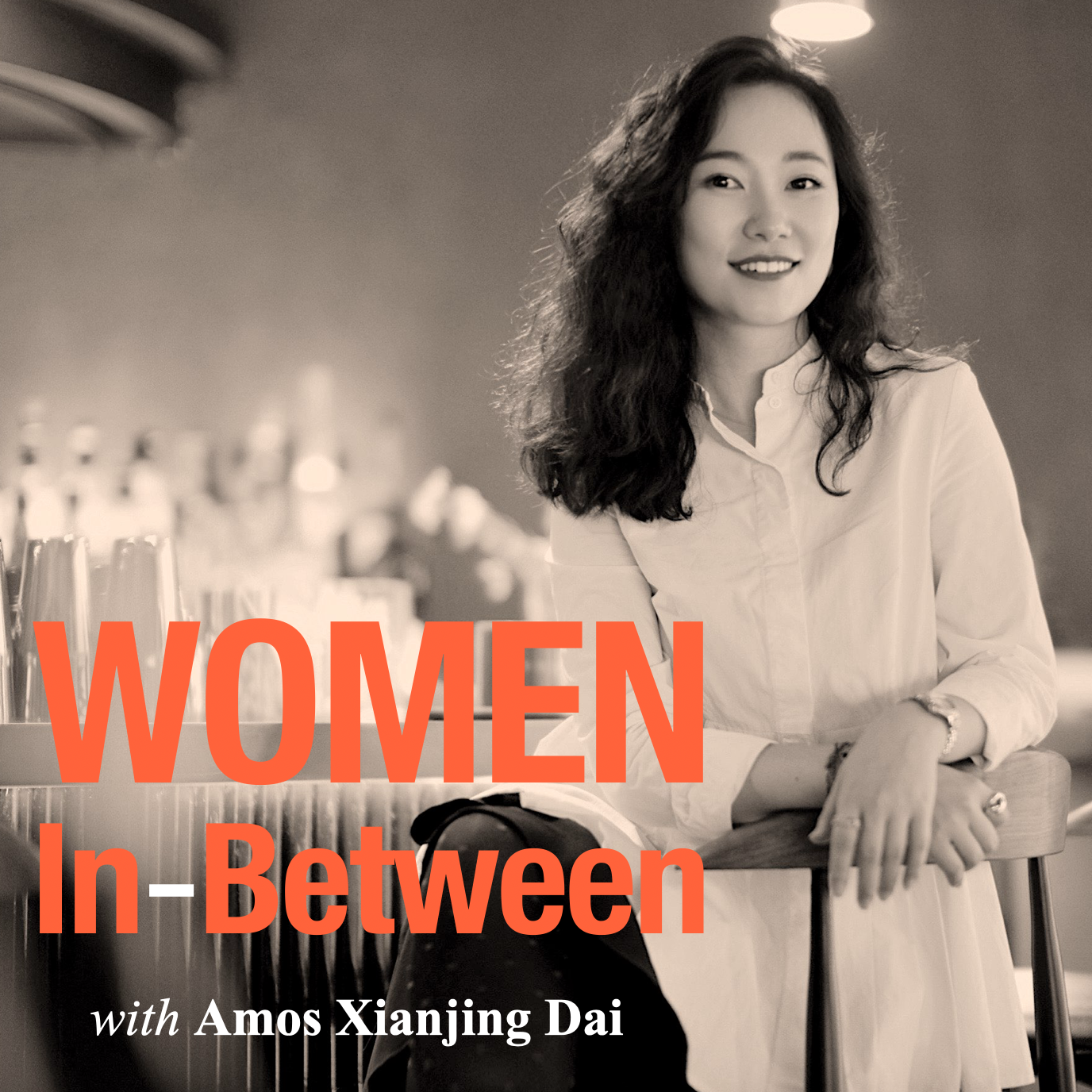
In-between, belonging to ourselves.
在东西之间,活出自己的答案。
We left. We stayed — just somewhere in between. A podcast hosted by Amos Xianjing Dai for Chinese-speaking women living in the U.S. — navigating the space between two worlds, where identity and belonging are still taking shape.
Between East and West. Between who we were expected to be and who we are becoming. Not through grand declarations, but through honest conversations about identity, courage, belonging, solitude, love, freedom, and the daily decisions that add up to one's life.
Made for those who know what it means to live in translation.




01 - She Left Everything at 40. Who Gets to Define Women's Time?
Zhang Wen was born in Beijing in 1983. At 40, she made a decision that few would dare: she disappeared from social life, buried herself in TOEFL prep, and applied to art schools in the United States. She never expected to receive an offer from RISD — Rhode Island School of Design — admitted without a single interview.
She graduated with an average 3.9 GPA. But the real thing she earned wasn't the degree — it was finally hearing herself clearly: who she is, what she's here to do. Her thesis, The Body Has Its Own Time, places a woman on a perpetually spinning platform — in Times Square, in quiet forests, in an ordinary kitchen — asking the question her work keeps returning to: when a woman's body and identity are constantly pulled by outside forces, when does she get to define her own time?
This is a story about leaving. About rebuilding. About the kind of freedom that only comes when thought and action finally align.
CH/EN Subtitle
02 - 13 Years in the U.S.: From Student to Professor of Art History. How to build women’s authority in academia?
Gillian Zhang has spent the past 13 years in the United States. Her journey began as a master's exchange student at UC Berkeley, followed by doctoral studies under Dr. Julia Andrews, a pioneering scholar of modern and contemporary Chinese art history. She later worked as a research fellow in the curatorial department at the Museum of Fine Arts, Boston. Today, she teaches East Asian Art History at Boston College.
She arrived with what she describes as "broken English" and eventually entered academia as a university professor. She moved from an education that emphasized conformity and graciousness to a life dedicated to exploring her own identity, finding her voice, and establishing her scholarly authority.
She says she loves challenges. She is often not part of the majority. Instead, she seeks out a space of her own within a complex world—and dedicates herself to cultivating it.
CH/EN Subtitle
03 - As a Visiting Scholar at Harvard: A Mental Transformation
Lina Fan graduated from the Digital Arts program at Camberwell College of Arts, University of the Arts London, and the School of Animation at Beijing Film Academy. She was also a Visiting Scholar at Harvard CAMLab, where her long-term research explores the relationship between art and technology.
At a recent academic gathering at Harvard, she shared insights from her time as a visiting scholar, reflecting on her ongoing exploration of visual art, artificial intelligence, and the inner landscapes of the mind. I was curious about what six months as a visiting scholar had meant to her. Even though it was only a temporary academic exchange, there is something unique about living in that in-between space—between cultures, institutions, and ways of thinking. What had the experience been like, both intellectually and personally?
She smiled and said, "It wasn't until I had made it through all the difficulties that I realized the most important person was myself. These six months have made me much more confident."
CH/EN Subtitle